


Canine Neuroscience 101: Stop Fighting Your Dog and Start Rewiring Their Brain

Let’s be honest. You’re here because you’re at the end of your rope.
You’ve done everything they told you to do. You went to the puppy classes. You watched the TV trainers. You practiced “sit,” “stay,” and “come” until you were blue in the face. You’ve been told to be the “alpha,” to use a special collar, to never let your dog win.
Yet, here you are – holding the leash of a lunging, barking, or trembling dog, feeling that familiar mix of frustration, embarrassment, and helplessness.
When it really matters—when another dog shows up, when the doorbell rings, when a skateboard rattles down the street—all that “training” evaporates into thin air.

You’ve been told your dog is “stubborn.” “Dominant.” “Reactive.” Or just plain “bad.” Professionals may have even given your dog these labels. And if you’re being brutally honest with yourself, you’ve probably thought it, too.
I’m here to tell you that’s a lie.
It’s the great misunderstanding that keeps millions of owners and dogs trapped in a vicious cycle of conflict and stress.
The problem isn’t your dog’s obedience. The problem is their brain state.
Your dog is not giving you a hard time; your dog is having a hard time.
In those high-stress moments, they are not choosing to disobey you. Their brain is biologically incapable of processing your commands. They aren’t being stubborn; they are in survival mode.
This is where traditional training methods don’t just fail—they can make things worse. This is where we stop fighting a war of muscle and start a revolution of the mind. This is the foundation of my Mind Over Muscle™ philosophy. We don’t need to control a dog’s body with tastier treats, more force, more corrections, or more volume. We need to learn how to lead their mind with calm, consistent, and clear guidance.
We need to stop battling the symptoms and start healing the root cause: a dysregulated nervous system.
Get ready to unlearn everything you thought you knew. Every bit of advice in this guide is aimed at one goal: using neuroscience to build a bond of trust and respect with your dog, so their brain wants to listen to you, and chooses to love you.

Have You Been Lied To About Your Dog?
The traditional approach to dog behaviour has created a devastating, self-perpetuating cycle of failure. It starts with one simple, catastrophic misinterpretation.
You see your dog lunge at another dog and you label it “reactive,” “aggression,” or “dominance.”
The advice you get is almost always the same: control the behaviour. Use a leash pop. Offer high-value treats. A louder voice. A “stronger” tool. Show them who’s boss.
But here’s what’s actually happening inside your dog’s head.
That lunge? In almost every case, it’s a desperate explosion of fear or over-arousal. It’s your dog screaming, “I need to go over there!” or “I feel unsafe! I need to make that thing go away!”
When you follow the old-school advice and apply a correction—a yank on the leash, a harsh word, a physical punishment—you are not addressing the fear.
You are adding another layer of pain and stress to an already terrifying situation.
Your dog’s brain – specifically the almond-sized alarm bell called the amygdala – learns a dangerous and tragic lesson: the appearance of another dog doesn’t just predict fear, it now predicts pain from the one person on this planet they are supposed to trust.
This floods their system with stress hormones like cortisol and adrenaline, pushing them deeper and deeper into survival mode. The thinking, logical part of their brain slams shut. They are now even less capable of learning, listening, or complying.
You see this continued reactivity not as a symptom of escalating fear, but as proof of your dog's "stubbornness."
So you correct harder.
And the cycle continues.
Your dog is sending you a clear message; "This situation is too much for me to handle!!"

Your frustration and your dog’s panic feed off each other, creating a co-escalating feedback loop of chaos. Trust is shattered. The bond is eroded. And the reactive behaviour becomes more and more ingrained with every single walk.
You are, unintentionally, training your dog to be more reactive.
This isn't a failure of your dog's character. It's the predictable, scientific outcome of a flawed and broken strategy. To achieve real, lasting change, we have to break this cycle. We have to change our entire understanding of dog psychology itself. And that means rethinking not just the old-forceful methods, but even the well-intended modern ones.
Why Reward-Based Training Also Fails, And Why Canine Neuroscience Wins
By now, you might be thinking: “Alright, I won’t yank the leash or yell. I’ll just use treats and praise to guide my dog.” After all, isn’t positive reinforcement the opposite of punishment? Isn’t it kinder and more effective?
In many ways, it is kinder – but if used predictably and without understanding your dog’s brain state, it can fail spectacularly too. This is the other lie that keeps dogs and owners stuck: the belief that we can simply bribe away fear and reactivity.
The truth is, extrinsic motivators like treats can backfire if they become the main dialogue between you and your dog. Sure, tossing a treat at a barking dog might momentarily interrupt the outburst. Your dog might even appear "trained" in a sterile environment, doing tricks for cookies. But under the surface, you may be rewarding the wrong brain.
And your dog has likely been trying to tell you this all along.
Think of what’s happening biologically.
When your dog is lunging and barking, they’re deep in their Working Brain (more on this split-brain concept soon). In that state, adrenaline is pumping and survival instincts have taken over.
If you dangle a piece of hot dog in front of them during a meltdown, one of two things will happen: either they’re too stressed to even eat (common when fear is over the top), or they snatch the treat in a frenzy without actually calming down. In both cases, the underlying emotion isn’t resolved. A treat is just a distraction, a band-aid on a bullet wound.
Worse, if every single time a trigger appears you shove a treat in your dog’s face, their brain can start to expect it. You haven’t taught them to feel safe; you’ve taught them to look for payment.
The scary dog appears, and your pup’s survival brain says, “Where’s my cookie?!” The focus isn’t on you or the environment – it’s on the transaction.
The moment you don’t have that treat, the fragile training crumbles. It’s the canine version of a student who only behaves when the teacher hands out candy and goes wild as soon as the candy jar is empty. The behaviour was never coming from a place of trust or self-regulation – it was “all about the money” (or in this case, the munchies).
No treat, no performance.

Predictable Rewards And Intrinsic Motivation Are The Enemy
Does this mean positive reinforcement is bad? Not at all.
It simply means that predictable, mechanical reward-based training is limited.
Neuroscience tells us why.
Studies on motivation show that when rewards are expected and routine, they actually diminish intrinsic motivation and learning. In a classic experiment, children who loved drawing were then "paid" for every drawing they completed with gold stars – and guess what? They lost interest in drawing once the gold stars were removed.
The external reward undermined their internal drive. They thought, “If I’m not getting a prize, why bother?”
Dogs are not so different. If your dog only comes to you because they know there’s a treat waiting, what happens when that external reward isn’t obvious? The “why bother” creeps in.
The dog hasn’t learned to enjoy coming to you or to feel safe and happy doing so – they were just working for the cookie. Over time, this can actually reduce their resilience and motivation to do things without a guaranteed payoff. It’s the hidden downside of purely reward-based training: it can keep your dog in a transactional, Working Brain mode, instead of truly engaging their thoughtful side.

Now, let’s talk brain chemicals for a moment.
One of the key players in reward-based training is dopamine – the “feel good” neurotransmitter associated with motivation, anticipation and pleasure. Dopamine is powerful; it’s what makes slot machines addictive and training rewarding. But here’s the catch: the pattern of rewards matters just as much as the reward itself.
Predictable rewards (like getting a treat every single time on a fixed schedule) will spark less and less dopamine over time as your dog’s brain says, “Yep, I knew that was coming.”
In fact, research confirms that a set and predictable reward reduces dopamine release over time, whereas unexpected or random rewards cause a much bigger dopamine spike.
In other words, certainty breeds boredom, while surprise creates joy.
If your training routine has become a boring certainty – a treat for every sit, a cookie for every come – your dog’s brain might actually be under-stimulated. They’re going through the motions for the treat, but their Pet Brain (the part capable of creative problem-solving and genuine choice) isn’t fully engaged.
It’s the difference between a student reciting facts for a grade versus a student genuinely curious and excited to learn. One is extrinsically motivated, the other intrinsically.
Not only can predictable treat-training flatten your dog’s enthusiasm, it can also keep them locked in an emotionally shallow state. Picture a dog who’s extremely “food-driven” – pupils dilated, laser-focused on the treat pouch, maybe even whining or pawing for the snack.
That dog might obey, but they’re not necessarily calm or confident. In many cases, they’re in a frantic, dopamine-fuelled seeking mode, which is still part of the Working Brain’s arousal spectrum.
They haven’t learned patience or resilience; they’ve learned how to get the cookie. If the cookie doesn’t come? Frustration and stress often follow – which means a spike of cortisol (the stress hormone) and a fast return to old reactive habits.
Let’s be clear: using rewards is not “wrong.”
The problem is when rewards become the only language you speak to your dog. A healthy training program uses rewards wisely – to mark desired behaviours and create positive associations – but it doesn’t rely on bribery or mindless repetition.
The goal is to gradually shift the motivation from external (treats, toys) to internal (enjoyment, communication, and trust). The treat should become a surprise bonus, not a payment plan. In fact, studies have shown that simply praising dogs or giving them social affection can be just as motivating as food – sometimes even more so.
In one brain imaging study, most dogs preferred praise from their owner over a food reward, or valued them equally; only a small minority were “chowhounds” who picked food first. This tells us that relationship is a primary reinforcer for many dogs.
Your attention and approval are inherently rewarding – if you’ve built that bond of trust.
So, if both the old coercive methods and the treat-heavy methods can fail, what actually works?
The answer lies in activating the right brain state.
We must communicate in a way that keeps our dogs in their Pet Brain (the calm, learning mode) and gradually makes them resilient to stress, without depending on either fear or food as a crutch.
We do this by building a line of comfortable communication – a feedback loop of trust and respect that taps into your dog’s social nature and intrinsic desires.
When your dog feels safe, understood, and connected with you, they want to follow your lead. They’re not responding out of fear of correction, nor are they calculating the cookie ROI. They’re responding because you have become a trusted guide and companion.
In the sections to come, we’ll dive deep into how to create this bond at the neurological level. You’ll see why obedience is an illusion when adrenaline takes over, and how Mind Over Muscle™ uses neuroscience to rewire your dog’s reactions.
By the end, you won’t think of yourself as a “trainer” doling out commands or treats – you’ll think of yourself as a brain-builder, an architect of choice, and above all, a communicator fluent in the language of your dog’s mind.

Obedience is an Illusion
Let’s get this straight right now: Obedience is overrated. Discipline is misunderstood.
I don’t care if your dog can hold a perfect “stay” in the living room if they fall apart the second the real world shows up.
That’s not a trained dog.
That’s a dog performing a trick in a sterile environment.
Similarly, I don’t care if your dog can do a dozen tricks for a handful of treats in your kitchen, but ignores you on a busy street or when you don’t have a cookie in hand.
That’s not a reliable partner; that’s a dog who has learned to tune you out unless conditions are perfect or payouts are guaranteed.
The real test isn’t “sit.” The real test is what happens when adrenaline enters the room.
And for most dogs, the answer is chaos.
The problem isn’t that your dog won’t listen.
The problem is that in that moment of panic, their brain can’t listen.
And if you don’t understand why, everything you build will crumble under pressure.
Obedience learned only under low stress or with constant rewards is an illusion – it appears solid, but it evaporates as soon as life gets real.
This is why we lead with the mind, not the muscle (and not the treat pouch). We focus on your dog’s mental state, not their outward compliance.
When you have your dog’s mind, their body will follow.
When you have their trust and respect, their obedience comes freely – not because you forced it or bribed it, but because you earned it.
The Two Brains: Why Your Dog Can't Hear You
There’s a war going on inside your dog’s head. Let's discuss canine neuroscience 101.
Not a metaphorical war.
A literal, biological, chemical battle between the part of the brain that wants to stay calm and the part that is screaming for survival.
Every bark, lunge, freeze, or shutdown isn’t “bad behaviour.” It’s brain biology in motion.
Your dog isn’t being difficult. They’re being hijacked.
And your job – if you want to be more than a frustrated owner – is to become the one who helps bring them back.
Not through control.
Through understanding and communication.
Through earning enough trust that you can gently guide their mind from panic to peace.

The Split-Mind Model
To start, you need to grasp a fundamental concept I call the "Two-Brain Model." Your dog operates with two distinct neurological systems. The one in control at any given moment determines everything.
The Working Brain (The Survival Engine) – This is your dog's limbic system, the ancient, primal part of the brain responsible for survival. It’s driven by instinct and raw emotion, not logic. Its job is to be on the clock 24/7, scanning the world for anything that looks like a threat, a problem, or a risk.
When it finds one? BOOM.
The floodgates open.
The brain’s threat-detection centre, the amygdala, pulls the fire alarm. This is called an amygdala hijack. It floods the entire system with a chemical cocktail of adrenaline and cortisol.
The heart rate spikes. The pupils dilate. Tunnel vision sets in.
This is when you see your dog “lose it.”
Leash reactivity, resource guarding, separation anxiety, and seemingly "uncontrollable" behaviours are all powered by the Working Brain.
In this state, your dog is not thinking.
They're reacting.
The Pet Brain (The Learning Partner) – On the other side of this internal battlefield is the Pet Brain. This is your dog's prefrontal cortex (PFC) – the more evolved, thoughtful part of the brain responsible for impulse control, decision-making, problem-solving, and emotional regulation.
This is the brain you can train.
The brain that can learn new things. The brain that allows for a true partnership.
A dog in its Pet Brain is calm, curious, social, and connected. It can process feedback, make good choices, and look to you for guidance.
Here’s the problem: The Working Brain is bigger, older, and more powerful. In dogs, the prefrontal cortex is proportionally much smaller than it is in humans. That means it can be easily overpowered and hijacked by a surge from the limbic system.
The entire goal of the Mind Over Muscle™ approach is to teach you how to keep your dog in their Pet Brain, and how to guide them back to it when the Working Brain tries to take over.
Everything we do – from managing environments to using calm rituals to how we reward – is about reinforcing the Pet Brain state (safety, trust, thinking) and avoiding triggering the Working Brain state (fear, chaos, instinct)

The Neurological Hijack: When the Lights Go Out
Trying to teach a command to a dog whose Working Brain is in control is what I call the "Calculus During a Fire Alarm" rule.
It’s pointless. It’s counterproductive.
You can’t ask someone to solve a complex math problem while their house is on fire. Their brain is biologically preoccupied with survival. Your voice is just more noise in the middle of a crisis.
When the Working Brain takes over, the Pet Brain goes offline.
This is not a choice.
It is a predictable, physiological process.
Your dog literally cannot hear you in any meaningful way.
Their auditory processing is being filtered for threats, not for the familiar sound of your voice asking for a "sit."
This is why even waving a juicy treat in front of a panicked dog often fails – their brain either doesn’t register it or is incapable of learning from it in that moment. (In fact, one hallmark of a severe stress response is a dog who won’t even take a treat they normally love, because the “rest and digest” system has shut down.)
Your attempt to shout commands or lure with food is like trying to reason with someone mid-panic attack – it just doesn’t land.
This is why your dog “knows” the command at home but “forgets” it on a walk.
At home, they’re in their calm Pet Brain.
On the street, surrounded by triggers, their Working Brain has slammed the door shut on learning and logic.
This isn’t disobedience. This is neurology.
And until you accept that, you will continue to fight a losing battle against your dog’s biology. You’ll keep trying more treats or harsher corrections, never understanding why it works in the backyard but fails when it matters.
The key is not to shout louder or bribe harder – it’s to get your dog’s brain back to a place where they can listen.

The Four Fs of Survival
When a dog is trapped in its Working Brain, it has a very limited menu of options, honed by millions of years of evolution. We call them the Four Fs:
Fight: “I will make the threat go away.” This is the lunging, barking, snarling, and snapping. It’s a desperate, fear-fueled attempt to create distance.
Flight: “I will get away from the threat.” This is the bolting, the frantic pulling, the scrambling to escape, the hiding behind your legs.
Freeze: “If I don’t move, maybe the threat won’t see me.” This is the sudden stiffness, the locked body, the held breath. This is a state of intense terror and is often the last stop before a Fight or Flight explosion.
Fawn (or Appease): “I will do anything to show the threat I am not a danger.” This can look like manic licking, frantic tail tucking, or rolling over in a non-relaxed way. It’s insecurity on full display.
When you see your dog exhibiting one of these behaviours, they are not being “bad.” They are telling you, in the only language they have in that moment, that their brain has been hijacked and they are fighting for their life.
This is the Working Brain in full control.
To make it clearer, let’s compare the Pet Brain and Working Brain side by side:
Feature | The Pet Brain (Prefrontal Cortex) | The Working Brain (Limbic System) |
Primary Function | Learning, Connection, Regulation | Survival, Reaction, Instinct |
Emotional State | Calm, Curious, Social, Playful | Anxious, Fearful, Reactive, Guarding |
Key Neurochemicals | Dopamine, Oxytocin, Serotonin | Cortisol, Adrenaline |
Behavioral Signs | Soft eyes, loose body, gentle tail wags, can disengage | Hard stare, stiff posture, rapid/tense tail wags, hyper-fixation |
Ability to Learn | High – Can process cues and make choices | None – Brain is hijacked; runs on instinct |
Your Mission | Reinforce and expand this state through calm rituals and clear communication | Recognize early signs, de-escalate, create distance, and guide back to Pet Brain |
Everything you do as a handler should be aimed at keeping your dog in Pet Brain or guiding them back to it.
This is where true learning and bonding occur.
Notice the “Key Neurochemicals” row: in Pet Brain we have dopamine (motivation), oxytocin (bonding), serotonin (well-being) – the good stuff.
In Working Brain, it’s cortisol and adrenaline – the stress cocktail.
Keep that in mind, because the chemistry of training is huge, and we’ll get to it in detail.

The Grassy Field in Their Head: Your Dog Isn't Broken, Their Path is Just Overgrown
So your dog is stuck in a reactive loop.
Their brain is hijacked by the Working Brain at the slightest trigger.
It feels hopeless. Permanent.
You’ve been told they’re “wired wrong” or “genetically broken.”
Another lie.
Here is the most powerful and hopeful truth in all of neuroscience: the brain can change. At any age.
This isn’t some feel-good mantra. This is a biological fact called neuroplasticity.
It is the brain’s built-in superpower to physically change its own structure and function based on experience.
Your dog’s brain is not a hardwired machine. It’s more like clay, constantly being molded and reshaped by every single interaction, every experience, and every repetition.
This is the reason no dog is ever truly a lost cause. And this is how we’re going to build them a new mind.
The Grassy Field Analogy: Building a New Brain Superhighway
I want you to picture your dog’s brain as a vast, dense, grassy field.
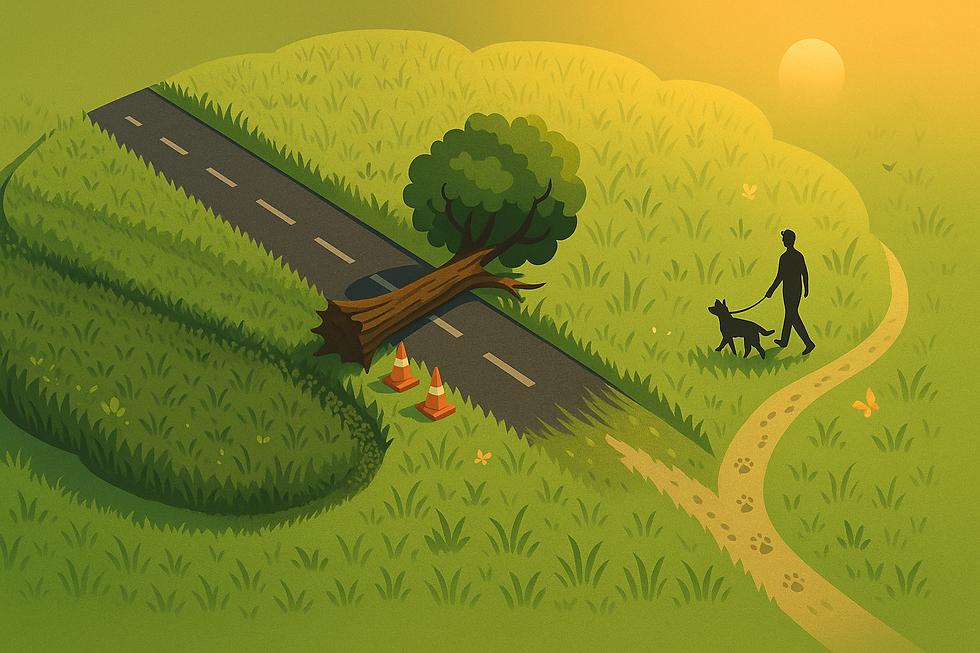
The Old Path: The Highway of Horror – Right now, your dog’s reactive behaviour – the lunging, the barking, the panic – is a wide, paved superhighway that cuts right through the middle of that field.
The first time your dog reacted to a trigger and it “worked” (the scary thing went away), it was like taking a single step into the grass, creating a faint path. The next time, the path got a little more defined.
After months or years of practice, that path has become a deep, wide, easy-to-follow dirt road.
It’s a neural pathway.
Every time you tense up on the leash when you see another dog, you are forcing your dog’s brain to walk down that same path. The dog sees the trigger, feels your tension, explodes, and you retreat.
Whoosh.
Another trip down the well-worn road.
That neural pathway becomes a superhighway of matted-down grass. The brain, being ruthlessly efficient, loves to take the easy road. It will always default to the strongest, most-traveled neural pathway available.
This isn’t a choice; it’s physics.
This is why the behaviour feels so automatic and unstoppable.
You’re not fighting your dog’s decision. You’re fighting a deeply ingrained, physical structure in their brain.

Blocking the Old Path: The Fallen Tree – So, how do we stop the cycle?
First, we have to block the old road.
This is where management comes in.
When we create distance from a trigger, when we use a U-turn on a walk, when we control the environment so the dog cannot have the explosive reaction, it’s like a giant tree has fallen and crashed right across the Highway of Horror.
The old route is blocked.
The dog is forced to stop.
Their brain hits a dead end and has to ask, for the first time in a long time, “What now?”
This is why preventing the rehearsal of bad behaviour is not a crutch or a sign of failure. It is a critical, non-negotiable neurological strategy.
You must stop your dog from practicing the panic if you ever want to teach them peace. Every outburst you prevent is a victory, because you’ve just denied the Highway of Horror one more rep.
Forging the New Path: The Calm Parkway – With the old superhighway blocked, we now have an opportunity.
We can guide the dog to take a new, first step into the tall, untamed grass right beside the old road.
This is the hard part.
This new path – the “Calm and Confident Parkway” – is faint and difficult to walk at first.
The grass is thick.
It requires conscious effort.
The brain will constantly try to pull back to the familiar, matted-down highway.
But every single time you successfully create a calm, positive experience in the presence of a trigger — every time your dog looks at another dog from a safe distance and stays calm — you are taking another footstep on that new trail.
The grass gets a little more trampled.
The path gets a little wider, a little clearer.
You are literally, physically, carving a new road in the landscape of your dog’s brain.
And here’s where using rewards strategically (not reflexively) comes in: When your dog manages to stay cool and make a good choice, then a well-timed treat or praise or play can be like tossing a few paving stones onto that new path.
It reinforces it.
The key is that the reward comes when your dog is in their Pet Brain, actually processing the situation well – not when they’re mid-meltdown. This way, you’re using dopamine to light up the right pathway (calm behaviour), rather than accidentally feeding the old fear highway.
The reward isn’t a bribe or an expectation; it’s a pleasant surprise that says “Yes, this new road is the place to be!”
The Final Transformation: Use It or Lose It – This is where the magic of neuroplasticity kicks in. With enough consistency and repetition, your new Calm Parkway becomes the brain’s preferred route.
It becomes wider, smoother, and faster. It becomes the new default superhighway.
And the old Highway of Horror?
It gets overgrown with weeds from disuse.
The brain operates on a simple, brutal principle: use it or lose it.
Neural connections that are not used weaken and are eventually eliminated in a process called synaptic pruning.
The old, reactive pathway literally starts to fade away.
This is not a metaphor.
You are an active participant in your dog’s neurological renovation.
You are a brain sculptor. And the tools you’re going to use are patience, consistency, and a deep understanding of how to make that new path the most rewarding one to take.
(Notice I said “rewarding” – not “easy.” Sometimes the new path is harder before it gets easier. But with your guidance, it will become more rewarding than the old behaviour. This is patterning the brain for resilience.)
Tying Your Own Hand Back: The Hard Work of Building a New Brain
You now understand that we can literally build a new brain for our dog.
We can forge new paths in that grassy field.
But let’s get one thing straight.
This is not easy.
This is not a quick fix.
This is hard, uncomfortable, and often frustrating work. And if you’re not willing to embrace that, you will fail.
To help you understand the real-world feeling of this process, I want you to try a thought experiment. This is The Dominant Hand Analogy.
Imagine, for the next 30 days, I tie your dominant hand behind your back.
Every single thing you do – brushing your teeth, eating a meal, writing a note, opening a door – you have to do with your non-dominant hand.
How would that feel?
At first, it would suck.
You would fumble everything.
It would feel slow, clumsy, and infuriating.
You’d get food on your shirt.
Your handwriting would look like a child’s.
You would want to rip that strap off your arm and go back to what’s easy, what’s automatic, what’s efficient.
That feeling – that deep, frustrating, awkward struggle – is exactly what your dog’s brain feels when we ask it to stop using its dominant, reactive Working Brain and start using its clumsy, unpracticed Pet Brain.
We are taking the “easy” limbic responses – the bark, the pull, the lunge, the spin – and tying them behind their back. Then we are forcing them to build the skill, the coordination, and the strength of their “off-hand,” the thoughtful, regulated Pet Brain.
And just like you with your non-dominant hand, this process reveals three brutal truths about how brains actually change:
You Don’t Force Control—You Build Capability. I can’t make your off-hand stronger by yelling at it. You have to build the muscle and coordination through practice. It’s the same with your dog. We don’t punish the failure; we create the conditions for the new skill to grow. (Yelling “use your left hand better!” at you wouldn’t help; neither does yelling “heel!” at a dog whose brain hasn’t built that pathway yet.)
You Don’t Punish Failure—You Create Repetition. You’re going to drop your fork. You’re going to spill your coffee. That’s part of the process. Punishing those mistakes would only make you anxious and less likely to succeed. Your dog will have setbacks. They will revert to the old, easy path. Our job isn’t to punish that. Our job is to calmly reset and create another successful repetition on the new path. (If your dog erupts, you don’t freak out. You peacefully end the scenario, and later, set up a situation where they can succeed at a slightly easier level. Reps, reps, reps – with as little drama as possible.)
You Don’t Get Instant Results—You Get Growth Under Pressure. This process is not about a single breakthrough moment. It’s about the slow, grinding, day-after-day commitment to doing the hard thing. It’s about growth that only happens when you are under the pressure of discomfort. The first week with your hand tied back, you see little progress; by the fourth week, you’re doing things you never thought you could. With your dog, the first few outings avoiding reactions might feel insignificant, but months later you realize those baby steps have become a giant leap in behaviour.

A man comically struggles to eat a bowl of spaghetti while his arms are playfully tied behind his back, highlighting the challenges of multitasking with your non-dominant hand in a humorous way.
Callousing Your Mind—and Theirs
This is where you have to get real with yourself.
This process isn’t just about your dog tying their hand back.
It’s about you tying yours back, too.
Your dominant hand is your old set of habits: tensing the leash, raising your voice, getting frustrated, feeling embarrassed, giving up on a walk early, or frantically reaching for a treat at the first hint of trouble.
Those are your easy, automatic reactions.
Those are your Highway of Horror, the well-worn paths of your brain.
Your new “off-hand” is the skill of being a Calm Captain (more on that soon). It’s going to feel clumsy and unnatural at first. You will have to consciously choose to take a deep breath instead of yelling. You will have to force yourself to loosen your grip on the leash when every instinct tells you to tighten it. You might have to hold back that reflex to shove a treat at your dog and instead calmly guide them with your voice and body.
You have to be willing to feel the frustration and not give in. As David Goggins would say, "you have to build calluses on your own brain".
Every time you stick with it, every time you choose the hard, calm response over the easy, reactive one (whether that reaction was anger or anxious bribing), you are not just helping your dog build a new path in their grassy field.
You are building a new one in yours.
This is the work.
It’s not pretty.
It’s not fast.
But it’s the only thing that creates real, lasting, unshakable change. You are literally training two brains at once: your dog’s and your own.
And together, you’re developing a new shared language of trust.

The Chemical Warfare: Your Dog's Inner Cocktail of Fear and Calm
Every feeling your dog has – every moment of panic, every sigh of relief – is underpinned by a complex and powerful soup of chemicals sloshing around in their brain and body.
Behaviour modification isn’t just about changing actions; it’s about changing chemistry.
The entire Mind Over Muscle™ framework is a system designed to help you become a master “neuro-bartender,” skillfully mixing a chemical cocktail that favours calm, confidence, and connection over fear and reactivity.
We want to flood the brain with the chemicals of trust and learning, not the chemicals of fear.
Let’s meet the four main ingredients in your dog’s inner potion shop.
The "Frazzle Juice": Cortisol & Adrenaline
When your dog's brain perceives a threat, the amygdala sounds the alarm. This triggers the release of adrenaline and cortisol.
Adrenaline is the emergency fuel. It’s a fast-acting hormone that gives your dog the instant burst of energy needed to fight or flee. It’s what powers that explosive lunge at the end of the leash.
Cortisol is the marathon stress hormone. It's released more slowly and sticks around in the system for much, much longer. Its job is to keep the body on high alert during a prolonged period of stress.
While essential for survival, chronically high levels of cortisol are toxic to the brain. Too much "frazzle juice" is scientifically proven to shrink the hippocampus (the brain's memory and learning centre) and enlarge the amygdala (the fear centre). Let me say that again: a chronically stressed dog literally becomes worse at learning and better at being scared.
This is the neurochemical trap that so many reactive dogs are stuck in.
This brings us to the 72-Hour Cortisol Rule.
This is non-negotiable.
After a major stressful event – like a big meltdown on a walk – it can take up to 72 hours for a dog's cortisol levels to return to baseline.
If your dog has a meltdown on Monday, and then on Tuesday you expose them to another stressful situation, their "stress cup" is already half-full.
It takes much less to make it overflow.
This is the science behind trigger stacking.
This is why giving your dog a "cortisol vacation" – a few days of quiet, calm, decompression walks and activities after a major event – is not coddling them or being boring. It is a biological necessity for their brain to heal and reset.
You’re letting the frazzle juice drain out before filling the cup again.
Think of it as a detox period to get your dog back to their learning mode.
The "Treasure-Hunt Fuel": Dopamine
Dopamine is the chemical of motivation, anticipation, and pleasure. It's released not just when a dog gets a reward, but when they anticipate getting one.
It’s the thrill of the hunt, the excitement of the game, the “Oh boy, something good is coming!” feeling.
Dopamine is what makes your dog's eyes light up when you grab the leash or a favourite toy.
It’s a powerful driver of behaviour and a key ingredient in making training fun.
It’s also central to the idea of reinforcement – behaviours that release dopamine will be repeated.
When we are carving that new, calm pathway in the grassy field, dopamine is the chemical that tells the brain, “Yes! This new path is awesome! Let’s do this again!” It’s the neurochemical that makes the hard work of learning feel good.
Every time your dog chooses to look at you instead of lunging at a trigger and you reward that with a happy “Good boy!” and maybe a treat or play, you’re giving a little hit of dopamine that says do that again.
Over time, the new behaviour literally becomes self-reinforcing because the brain now finds it rewarding to do fun things with you, not to get fun things from you.
However – and this is critical – we must use dopamine wisely.
As we discussed in the section on reward-based training, a predictable dopamine drip (same reward every time) can cause the brain to yawn.
But a well-timed, somewhat unexpected reward causes dopamine to spike and really marks the moment.
This is why variable reinforcement (rewarding some of the time, unpredictably) often creates more robust behaviour than rewarding every single repetition. We are basically harnessing the dog’s natural “treasure hunt” instincts – maybe the next one will pay off big! – to keep them eager and engaged.
Dopamine is our ally in building new habits.
We just have to ensure we are rewarding the Pet Brain behaviours, not the Working Brain ones. When used correctly, dopamine makes learning feel like a game for your dog – and they’ll want to play that game with you over and over.
The "Bond Chemical": Oxytocin
This is the magic one. This is the secret weapon.
Oxytocin is the powerful "cuddle chemical" of social bonding, trust, and love. It's released in both your brain and your dog's brain during moments of positive connection: mutual gazing, gentle petting, play, relaxed time together.
If you’ve ever felt a rush of warmth while snuggling your dog and looking into their eyes, that’s oxytocin at work in both of you.
Here’s the most important part: Oxytocin is the natural antidote to cortisol. It directly calms the amygdala, reducing fear and anxiety. It promotes feelings of safety and security. It makes your dog want to connect with you.
An oxytocin-rich relationship is like a protective bubble around your dog’s mind – a neurochemical shield against the stresses of the world.
This is why the battle between training methods is so critical.
Punishment-based training floods the brain with Frazzle Juice (cortisol and adrenaline). It creates a dog that is marinating in stress hormones, a dog whose brain is physically degrading in its capacity to learn and cope.
A relationship-focused, Mind Over Muscle™ approach intentionally cultivates oxytocin. It builds a brain that is resilient to stress because it is constantly bathed in the chemistry of safety and connection.
When your dog trusts you deeply, just being near you and hearing your calm voice can start to calm them down chemically.
You become their safety signal.
Importantly, oxytocin isn’t generated by a cookie or a clicker – it’s generated by you.
Your presence, your touch, your calm and loving interactions are what spike oxytocin in your dog’s brain.
A treat is nice, but it doesn’t create the same bond hormone. (In fact, one study found that dogs’ reward centres respond strongly to the scent of their favourite humans, even more than to the scent of food or other dogs.) This means your relationship is a chemical force-multiplier that no amount of treats can replace. If you focus on building trust and positive communication, you’re literally dosing your dog’s brain with oxytocin regularly, which makes them less prone to fear and reactivity over time.
You are not just a trainer; you are a chemist. And the potion you are mixing every single day is the very essence of your dog's well-being and their ability to change.
The recipe we want is high in oxytocin and dopamine, low in cortisol and adrenaline.
Keep that in mind: every interaction either feeds one side or the other.
When in doubt, ask: Is what I’m about to do likely to make my dog feel safer and more bonded with me, or more threatened and stressed?
Let the answer guide you.

You Are the Leash: Becoming the Calm Captain in Their Storm
We’ve talked about your dog’s brain.
We’ve talked about their chemistry.
Now it’s time to talk about the single most influential factor in their environment.
You.
Here is the hardest and most important truth you will ever learn about your dog: the emotional state you see in them is very often a reflection of your own.
Your dog is your mirror.
They are equipped with a highly sensitive radio receiver, perfectly tuned to your specific emotional frequency.
They don’t just hear your words; they feel your intention.
They feel your stress, your anger, your frustration, your anxiety, your joy, and your calm.
They can even smell it.
Research has shown that dogs can detect the chemical changes in our sweat and breath when our own cortisol levels rise.
So when you get anxious about that approaching dog, you are literally releasing a scent that tells your dog, “It’s time to be stressed now.” Your tightened leash and quickened breath broadcast a clear message: Captain is worried, so I should be too.
This phenomenon is called co-regulation. It’s the process where the nervous systems of two socially bonded individuals can sync up and influence each other.
Think of it as emotional Wi-Fi.
You are constantly broadcasting a signal, and your dog’s brain is constantly receiving it.
If your signal is “Panic! Fear! Frustration!”, your dog’s brain will sync to that frequency.
If your signal is “I am calm. I am confident. We are safe.”, you provide a powerful, steady beacon that their nervous system can lock onto, allowing it to start calming down.
Be the thermostat, not the thermometer.
A thermometer simply reflects the temperature of the room.
A thermostat sets the temperature of the room.
Most handlers act like thermometers.
They see their dog getting frantic, so they get frantic.
They feel their dog’s anxiety, so they become anxious.
Their energy just reflects and amplifies the chaos.
A Calm Captain is a thermostat.
They walk into a chaotic situation and, through their own deliberate calm, they change the emotional temperature of the entire interaction. They don't get sucked into the storm; they become the eye of the storm – that calm, steady centre that doesn’t move while the winds rage around.
This is not touchy-feely talk; this is neuroscience.
Your dog’s mirror neurons are reading your body language.
Their olfactory system is reading your hormones.
Their entire evolutionary history as a pack animal attunes them to the emotions of their leader. In a very real sense, if you can master yourself, you can master your dog's reactions.
Think of yourself as a living leash.
The physical leash in your hand is just a piece of material.
You are the real leash, in the sense that you connect to your dog and transmit signals down that line.
If you remain loose and relaxed, that message travels right into your dog’s nervous system: “All is well.” If you yank or tense up, the opposite message blares: “Red alert!”

Leadership as Neurological Scaffolding
This brings us to the most profound concept in this entire guide.
This is how you redefine leadership from a dominance fantasy (“alpha rolling” and all that nonsense) to a neurobiological reality.
Imagine a building being constructed.
At first, it's weak and unstable.
So, the builders erect a huge, strong metal scaffold around it.
The scaffold doesn't become the building, but it supports the structure, allowing the workers to safely build the walls from the inside out. Once the building is stable on its own, the scaffolding is removed.
A dog with a reactive brain is like that unfinished building.
Their own internal scaffolding – their prefrontal cortex, the part of the brain responsible for impulse control – is underdeveloped or gets knocked offline by stress.
They can't support themselves in the face of a storm (the triggers).
A "muscle-based" handler sees the shaky building and just tries to hold it up with brute force or gadgets. It’s exhausting, and it doesn’t make the building any stronger on its own.
A "cookie-based" handler might try to decorate the building with treats, hoping it sticks together, but without support it still wobbles at the first sign of trouble.
A "mind-based" handler – a Calm Captain – becomes the scaffolding.
Here’s how it works:
A trigger appears.
Your dog's survival brain starts to sound the alarm.
But you, the scaffold, remain calm.
Your breathing is slow.
Your body is relaxed.
Your emotional Wi-Fi is broadcasting “we are safe.”
This signal of safety from you, their trusted leader, tells their amygdala to chill out. It’s like you’re whispering to their brain, "It's okay, I've checked it out. It's not a fire."
Because the alarm isn't blaring at full volume, their thinking brain (the Pet Brain) stays online. It doesn't get evacuated.
Now, your dog can observe the trigger without panicking. They can process the information instead of just reacting to it. They might still be uneasy, but they’re holding it together.
In that moment, their brain carves a new, tiny neural pathway in that grassy field: "I saw a dog, and the world didn't end. I felt safe because my human was calm and had my back."
This is huge.
That right there is a footstep on the Calm Parkway.
Every single time you do this, you are helping them build their own internal structure. You are lending them the strength of your regulated nervous system so they can build their own.
Over time, with hundreds of repetitions, their own brain becomes strong and resilient. Eventually, they don't need to borrow your calm as much, because they have cultivated their own.
The scaffolding can gradually come down.
That’s the day your dog who used to explode at triggers now glances at one and then looks to you like, “Hey, we’re cool, right?” – and you are, because you’ve taught them how to be.
This is the most profound and active form of leadership there is.
You are not just leading their body; you are providing the literal blueprint their brain needs to rewire itself for a lifetime of confidence.
You’ve established a line of communication so secure and comfortable that your dog trusts your signals more than their fear. That is the pinnacle of the trust-respect bond.
Remember: The leash in your hand is not a tool for pulling.
It is an antenna, transmitting the truth of your internal state directly into the emotional centre of your dog's brain.
Make sure you’re sending the right signal.
Be the guide, the steady hand, the Calm Captain your dog needs.
The most powerful act of "dog training" you will ever perform has nothing to do with your dog.
It is the quiet, difficult, and transformative work of learning to master yourself.
The Blueprint for a Bulletproof Brain: Your New Mission
You now have the map.
You have the science.
You understand that the barking, the lunging, the fear – it is not a flaw in your dog's character. It is a fire in their brain.
And you now know that you cannot fight that fire with force, nor can you bribe it into submission with cookies.
You must meet it with a profound and unshakable calm.
You must become the water that soothes the flame.
You must become the teacher who builds understanding, not just obedience.
This is where we stop “training” and start living.
This is where the conscious, deliberate practice of these principles starts to fade into the background, replaced by a new, intuitive, and deeply connected way of being with your dog. The leash tension, the treat bargaining, the old habits – they start to disappear. In their place emerges a fluent conversation between you and your dog.
The goal was never to teach you a set of commands. The goal was to give you a new language. A language of energy, of neuroscience, of trust.
Now, it’s time to become fluent.
Pattern Over Pressure
Lasting change is forged in the quiet consistency of daily rituals, not in the loud intensity of occasional training sessions.
Your dog’s brain is a pattern-seeking machine.
It craves predictability because, in the wild, predictability equals safety. (Remember, a brain that knows what to expect is a brain that doesn’t have to waste energy being anxious or hyper-vigilant – it can relax.)
This is why intentional balanced daily rituals are the most powerful tool in your long-term toolkit. Every time you engage in a calm, confident ritual, you are strengthening new "calm listener" neural pathways. You are paving and widening those new superhighways in the grassy field of their mind, no longer making self-regulation their default.
For example, a simple ritual like practicing creating a calm, desensitized pre-walk ritual in the house – same routine, put on the same shoes, pick up the same leash, no surprises – can break predictable patterns that lower your dog’s baseline stress for the day. But instead of actually going for the walk, go put the leash down and begin making your morning coffee like nothing happened.
How does your dog respond? Confused?
Breaking these little, predictable patterns, done consistently, cause your dog to begin thinking instead of reacting. Creating stability in your dog’s life, guided by you, not assumption.
They also build trust: your dog starts to predict that good things happen regularly when they pay attention, and that you are a reliable, steady presence. That trust in turn feeds more oxytocin and serotonin, which further cements the calm brain states.
Think patterns, not pressure.
Instead of thinking, “How can I correct or compel my dog in the moment they’re misbehaving?”, think, “What positive pattern can I set up in advance to prepare for or prevent that misbehaviour? What can make it easier for them to choose the right behaviour?”
Use educated structure and unpredictable routine as your allies.
A dog that stops knowing what’s expected and begins to see a pattern of calm leadership emerging will naturally begin to mirror that calm.
Architect of Choice
Your new role is not "dog trainer." It is Architect of Successful Choices.
A choice made is infinitely more powerful for the brain than a command followed. When a dog voluntarily chooses to disengage from a trigger or offer a calm behaviour, they are actively using their prefrontal cortex. They are doing a bicep curl for their brain's CEO (the Pet Brain).
Every time your dog chooses to come to you instead of chasing a squirrel, or lies down instead of barking at the window, it’s like watching their Pet Brain do push-ups – it gets stronger and more automatic each time.
Your job is to become a brilliant architect who structures the environment in such a way that the calm, correct choice is the easiest and most obvious one for your dog to make.
We set them up to win, repeatedly, until making good choices becomes their habit (their new highway).
Example: The Doorway Ritual
Let’s compare two approaches:
The Old Way (Command-Based): You tell your dog to "Sit" and "Stay" at the open door. You might have to physically block them or keep repeating the command. Maybe you’ve got a treat in hand, and you’re saying “staaaay…staaaay…” while your dog vibrates in place. You are managing the situation with verbal (and edible) pressure. The dog is obeying because you’re micromanaging and probably because they see that treat or fear you slamming the door if they move.
The New Way (Choice-Based): You put your hand on the doorknob. If your dog rushes forward, your hand comes off the knob immediately. Door doesn’t open. You say nothing. No eye contact. You’ve removed the possibility of predictable reinforcement (going outside) by removing your hand. You wait calmly. Maybe your dog backs up a step or gives you a puzzled look. Good. You put your hand back on the knob. They surge forward again – oops, hand comes off again, door stays closed. Still no words, no leash corrections, no treats – just cause and effect. You try again. You walk away from the door. You come back five minutes later. You reach for the knob again. This time, your dog hesitates or stays put as your hand goes to the knob. Aha! You quietly open the door. If the dog starts to bolt through, the door swiftly closes again. No anger, just swift action – the opportunity vanishes. You try again, walk away for ten minutes this time. Perhaps after a couple of tries, your dog chooses to wait at the threshold as you open the door wide. Boom – jackpot! You cheerfully invite them through by walking through the door yourself. (What then happens outside the door is a different exercise.)
In this silent game, the dog’s brain isn't learning to obey the word "stay."
It's learning a much deeper concept through choice: "My own calm, self-controlled behaviour is what makes the good stuff happen."
Their Pet Brain is engaged, because they are figuring out the puzzle.
They learn that rushing gets them nowhere, literally, but patience makes the world open up. They are not waiting for a command or a treat; they are learning a state of being that earns them freedom.
Notice how comfortable this line of communication is compared to yelling or constant feeding.
You’re not fighting with your dog, nor bribing them – you’re simply communicating the rules of the world in a way they can understand and trust. And when they “get it,” you better believe there’s a dose of dopamine in their brain from that moment of success.
You might reinforce with a “good dog!” or a pet once they’re outside (adding a bit of oxytocin to the mix), but the real lesson was learned in the decision they made. This builds respect – “Hey, my human is fair and clear. I choose to listen to them.”
When you start thinking like an architect of choices, you stop seeing training moments as confrontations or trick competitions and start seeing them as learning opportunities. Every situation is a chance to let your dog practice making a good decision – and to feel good making it.
Over time, your dog’s brain learns that choosing wisely is the most rewarding, stress-free, trust-filled path. They essentially train themselves with your guidance. This is how you create a dog who listens because they want to, not because you’re forcing or bribing them.
Final Rally Cry
Stop being a dog trainer. Start being a communicator. A brain builder.
Stop being a commander. Start being an architect of choice.
Stop focusing on obedience. Start focusing on communication and trust.
Your goal is not to have the most obedient dog on the block. Your goal is to have the most mentally and emotionally resilient dog – a dog who trusts you so completely, who respects you so deeply, and who has practiced making good choices so often that they can navigate the world with quiet confidence. A dog with a brain that not only can listen to you, but wants to listen to you, because listening to you has always led to safety and rewards and understanding.
This is the Mind Over Muscle™ revolution.
It's quiet.
It's patient.
It's strategic. And it will change everything. Permanently.
Your dog doesn’t need another command. It needs a new chance to feel safe and understood. It needs a bond built on trust and respect. It needs a line of communication that it can rely on no matter what.
The war inside their brain can be won. The reactive paths can be rerouted.
The frenetic Working Brain can learn to relax into the Pet Brain.
And it starts with you. Let’s get to work!


Comments